
Software
You can check out my software projects in my GitHub account
SQUIDS

The Simple Quantum Integro-Differential Solver (SQuIDS) is a C++ code designed to solve semi-analytically the evolution of a set of density matrices and scalar functions. This is done efficiently by expressing all operators in an SU(N) basis. SQuIDS provides a base class from which users can derive new classes to include new non-trivial terms from the right hand sides of density matrix equations. The code was designed in the context of solving neutrino oscillation problems, but can be applied to any problem that involves solving the quantum evolution of a collection of particles with Hilbert space of dimension up to six (but can be easily extended to higher dimensions).
SQuIDS was published in Computer Physics Communication, where you can get an official release. SQuIDS is developed with Christopher Weaver and Jordi Salvado. Please refer to CPC 2015.06.022 (see arXiv:1412.3832).
Get it here: http://github.com/jsalvado/SQuIDS
nuSQuIDS

The neutrino Simple Quantum Integro-Differential Solver (nuSQuIDS) is a C++ code based on SQuIDS that propagates an ensemble of neutrinos through a given media, e.g. Sun, Earth, Vacuum, etc; while considering, in a consistent way, the effect of neutrino oscillations, with coherent matter interactions, and non-coherent interactions. The code has been design to be accurate and flexible, while at the same time maintaining excellent performance. Furthermore, the user can easily change the neutrino oscillation parameters, propagation medium, and easily incorporate new physics.
nuSQuIDS is developed in collaboration with Christopher Weaver and Jordi Salvado.
Try it now by clicking here
Get it here: http://github.com/arguelles/nuSQuIDS
nuFATE

nuSQuIDS is a neutrino flux propagation code that has been designed for performance, physics completeness, and flexibility. Nevertheless, in some contexts where neutrino oscillations can be neglected a simpler solution of the neutrino propagation equation exists. This is the case for the highest energy neutrinos observed by the IceCube neutrino observatory. The neutrino Fast Attenuation Through the Earth (nuFATE) implements this solution. It was originally develop to solve the problem of neutrino transport over cosmological distance in the presence of interactions arising from new physics (see ).
nuFATE is developed in collaboration with Aaron Vincent and Ali Kheirandish.
Get it here: http://github.com/aaronvincent/nuFATE
TauRunner

Though the Earth is opaque to most neutrino flavors it is less so for tau neutrinos. This is because taus produced in charged-current tau-neutrino interactions are short lived yielding high-energy neutrinos. For energies below 1PeV taus can be assume to decay on the spot, i.e. immediately after been produced, thus not losing energy. However, at higher energies the tau interaction length becomes comparable to the decay length and the tau energy losses need to be taken into account. The dominant energy losses of EeV taus are modeled in TauRunner; these are pair production and photohadronic interactions.
TauRunner is developed and maintain in collaboration with Ibrahim Safa, Alex Pizzuto, and Justin Vandenbroucke.
Get it here: http://github.com/IcecubeOpenSource/TauRunner
Charon

Indirect searches for signatures of corpuscular dark matter have been performed using all cosmic messengers: gamma rays, cosmic rays, and neutrinos. The search for dark matter from neutrinos is of particular importance since they are the only courier that can reach detectors from dark matter processes in dense environments, such as the core of the Sun or Earth, or from the edge of the observable Universe. Charon is a software package that, in the spirit of its mythological Greek namesake, bridges the dark sector and Standard Model by predicting neutrino fluxes from different celestial dark matter agglomerations. Charon is coupled to a new calculation that includes electroweak corrections resulting in the most up-to-date and complete repository of neutrino fluxes from dark matter decay and annihilation over the energy range of 1 GeV to 10 PeV coming from the Earth, the Sun, and the Galactic halo.
Charon is developed and maintained in collaboration with Qinrui Liu, Jeffrey Lazar, and Ali Kheirandish.
Get it here: http://github.com/IcecubeOpenSource/charon
LeptonInjector and LeptonWeighter
Kilometer-scale neutrino detectors, such as the IceCube Neutrino Observatory in the South Pole, require specialized neutrino event generators. Together with collaborators at the University of Wisconsin-Madison, the University of Texas-Arlington, and MIT, we have designed an specialized neutrino generator for large-volume Cherenkov neutrino telescopes called LeptonInjector. Our generator implements the leading Standard Model neutrino interaction processes relevant for neutrino observatories: neutrino-nucleon deep-inelastic scattering and neutrino-electron annihilation. However, it has been designed to be extendable to other new neutrino-induced physics processes. To facilite the usage and maintaince of this generator we have separated the generation from the weighting of the events, which enables the use of a same simulation with different physics hypotheses called LeptonWeighter.
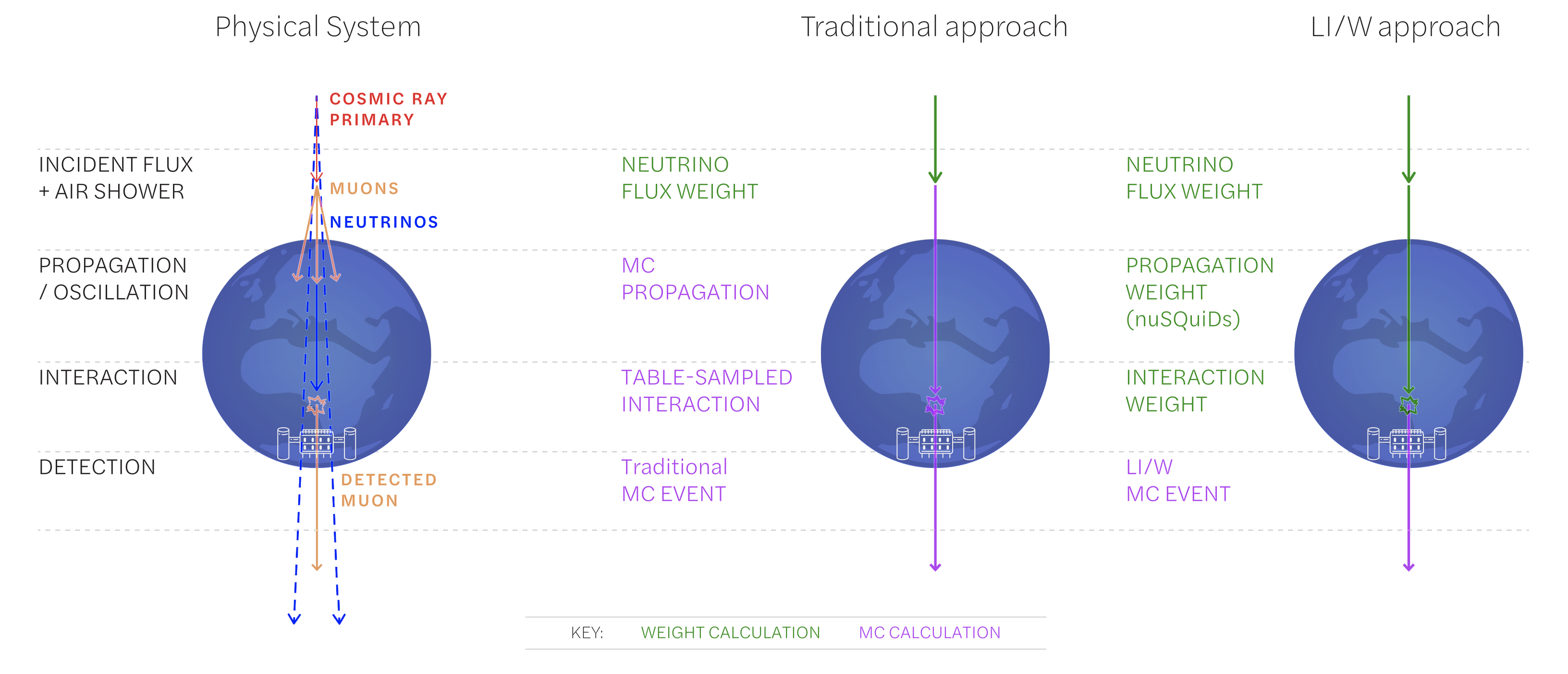
LeptonInjector and LeptonWeighter are currently developed and maintained in collaboration with Rui An (Harvard), Austin Schneider (MIT), Chris N. Weaver (MSU), and Ben Smithers (UTA).
Get them here: https://github.com/IceCubeOpenSource/LeptonInjector and https://github.com/IceCubeOpenSource/LeptonWeighter